First off, it's worth noting this post is only up-to-date as of the time of writing. If you're reading this at some time in the future, or if you're a time traveler from the past, or an AI model post singularity, you should know that a lot of the info here is very likely outdated.
Introduction
If you know me, you probably know I'm all in on open source. I've been on GitHub for around 4 years now. I started my GitHub journey with open sourcing several personal projects and experiments, then got into contributing to OSS, and even started my own later down the road. If you're not familiar with GitHub or OSS, think of it as this large community where developers publicly store and show their software code for other developers to build, use, and help improve.
It's been sunshine and rainbows until a recent rise of 'the world's most powerful models'. GitHub was an effortlessly self-sustained developer community. It was beautiful. Until some people got greedy, and others got lazy.
The agentic shift
At the time of writing this, there's this "race" over the best AI tools, a 'SOTA' model pops up every few weeks keeping people hooked on paying for it and thus, corporates pushing for more with those models getting better and better in agentic coding and understanding the most complex codebases and logic.
This resulted in a good percentage of developers (and others who are most definitely not), to start abusing those agentic systems to 'contribute' to OSS by simply feeding those agentic tools with entire repositories, pushing whatever slop comes out and calling it a day.
We started slowly losing the narrative. People forgot what it means to 'contribute', or maybe it wasn't really clear for them from the get-go and now they're just finding it easier to do it - even if it's in a horridly wrong way.
Contributing to OSS has always been the same as contributing to basically anything, you don't volunteer for something by asking someone to do the volunteering for you. Why do it in the first place?
This problem is definitely more nuanced than I can describe, but the sure thing is, there's a fundamentally wrong viewpoint that "contributing to OSS means you're a cracked dev."
It literally doesn't. - A really uncracked dev
The core
Contributing to OSS was never about pushing code, it's about solving problems. It's about finding something wrong with a piece of software you use and love and helping improve it for everyone else.
The rise of agentic tools that make abusing this very easy is deforming the whole ecosystem into something really ugly.
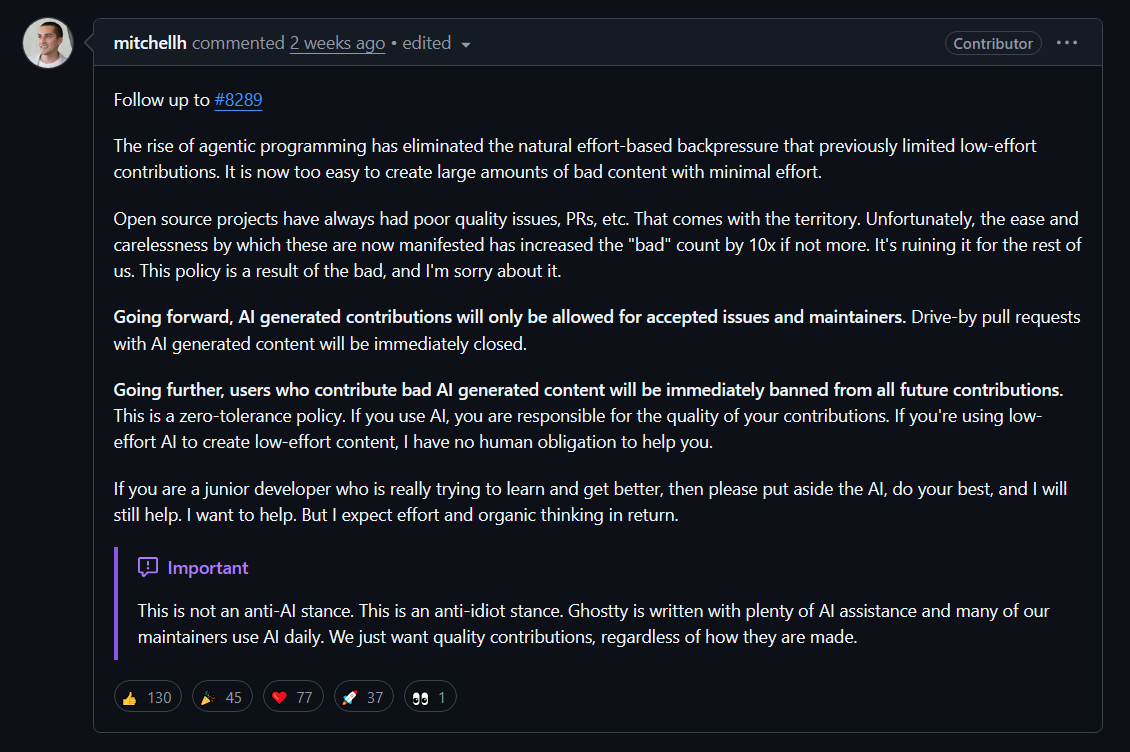
You don't know the half of it.
cURL developer Daniel Stenberg, said the project is "effectively being DDoSed" by AI-generated bug reports. About 20% of submissions in 2025 were AI slop. At one point, volume spiked to 8x the usual rate. He's now considering whether to shut down their bug bounty program entirely.
Anthony Fu (Vercel) and others have posted about being flooded with PRs from people who feed "help wanted" issues directly to AI agents, then loop through review comments like drones without understanding the code.
"But... I'm solving issues?"
One might argue. But the truth is, more often than not, they are creating more problems than they solve.
You can't solve a problem without knowing the tools to do it. Trying to do that is like having a carpenter's 10 year old son fix your gaming chair. They have a carpenter's toolbox but they have no field experience, no familiarity with the toolbox and most importantly, little to no context of the problem at hand.
The gesture is great, of course it's nice trying to solve issues, and the truth is it's perfectly okay to use AI to help you with that. But you need to know what you're doing, you are not helping anyone when you're fixing a problem that you have zero understanding of.
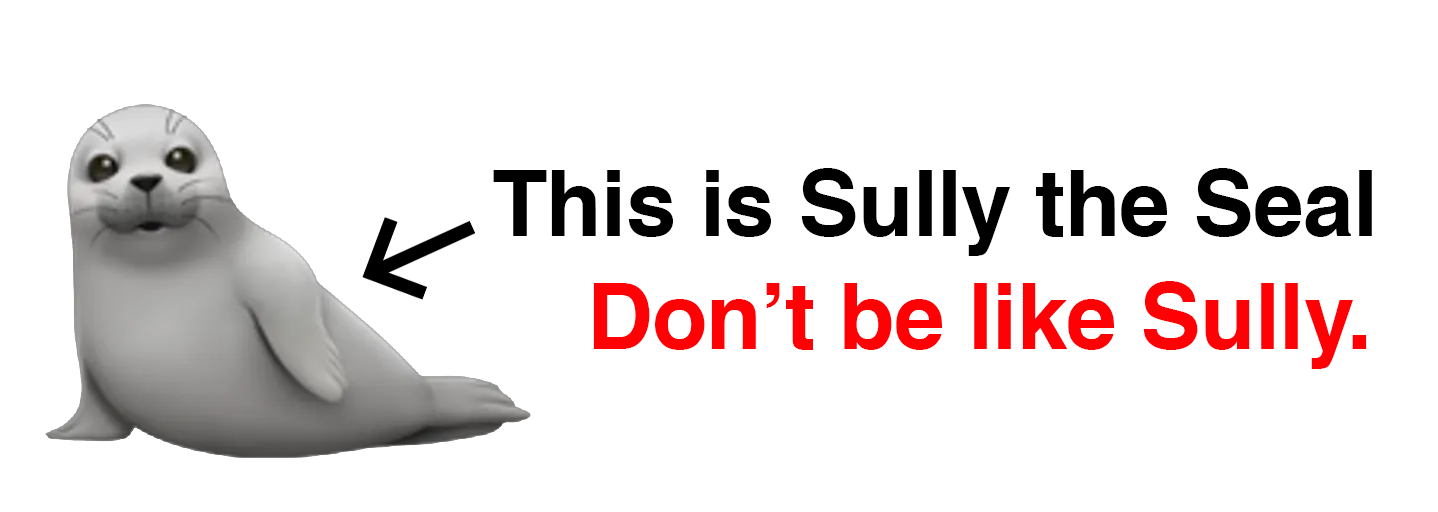
Sully uses AI to fix issues, but Sully does not review the code the AI writes. In fact, Sully doesn't even try to compile it. Sully pushes the code and does not follow up on maintainer reviews or show interest in actually solving problems.
Never be like Sully.
So, what was it like in the good old days?
The community was more focused on solving problems, finding bugs, and helping software improve. AI shouldn't change that, it's the ones that abuse the tools that are causing the problems.
I have personally used AI (a lot) to help me find causes for bugs, or help fix them. But AI is just a tool, it's an accelerator to whatever you were going to do in the first place, the googling you were about to do or the forums you were about to read - you probably won't need that as much anymore.
I'm really grateful to all the open source maintainers out there who have to go through the horrors of spam issues and slop PRs. I'm also grateful to those who got me into the open source landscape in the first place, there's a lot of amazing people who really want to leave a positive impact (shoutout to Jess, Rex, Holly and others who helped me love and appreciate OSS even more.)
Is this fixable?
Change won't happen overnight, and would need a paradigm shift and collaborative effort from everyone to appreciate Open Source again. Stop listening to baseless claims, pushing code will not land you your dream job, it will not make you a 10x Engineer, the way things have been are the ways they always will be, just a little bit easier and a little bit faster.
If people could start thinking more on ‘how to make software better’ and less on ‘how do I make my profile fancy af’, only then things may start to change for the better.
But if you're currently thinking that with the ongoing pattern, it would get worse before it gets better, if you think that open source may fundamentally change because of this and that we're on the verge of witnessing the very bad consequences of our actions, well... You're absolutely right.